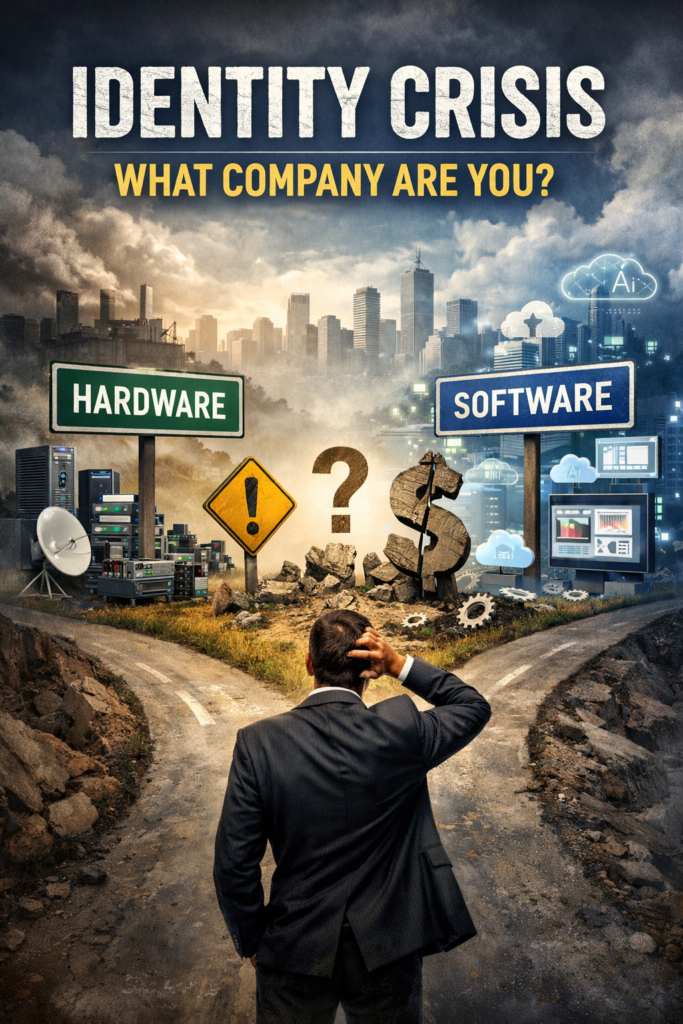
Lately, I keep seeing the same pattern in sales pitches, strategy decks, and product positioning across the industry. A lot of companies seem to be having an identity crisis.
What company are you, really?
Are you a hardware company trying to act like a software company? Are you a software company trying to justify a SaaS model that no longer delivers meaningful value? Or are you simply trying to attach recurring revenue to products and services that were never designed to create that kind of operational impact?
As an operator, I look at every platform through a very different lens.
I am not interested in software because it sounds modern. I am not interested in AI because it looks good in a demo. I am not interested in recurring fees because a vendor wants more predictable revenue.
I care about efficiency.
I care about operational impact.
I care about whether the tool improves execution, reduces complexity, and increases EBITDA.
If it does not do those things, then it is not transformation. It is just another expense.
This is where many legacy software-minded companies are starting to get exposed. For years, the model worked. Build complexity, wrap it in a contract, lock customers into a process, and collect revenue over time. But that approach is losing ground fast.
Why? Because operators are no longer forced to accept it.
Today, AI, machine learning, and automation are changing the economics of software itself. Companies can now build highly targeted internal applications, automate workflows that used to require bloated third-party systems, and eliminate layers of operational drag that legacy vendors once convinced everyone were unavoidable.
We have done exactly that.
We have replaced multiple SaaS platforms with internally developed applications that use AI, machine learning, and automation to simplify workflows and remove outdated, overcomplicated vendor approaches. Not because building internally is always the answer, but because too many external systems had become expensive, rigid, and disconnected from the real needs of the operation.
That is the shift many vendors still do not fully understand.
This is not just a product problem. It is a leadership problem.
Companies that fail to adapt to this new reality will decline. Some already are. This is how once-dominant companies lose relevance. This is how boards lose confidence. This is how CEOs get replaced.
When leadership continues to defend legacy thinking in a market that is rapidly changing, the outcome is predictable. The company falls behind, customers look elsewhere, and the valuation eventually reflects that failure to evolve.
The message to vendors is simple.
Do not tell me your platform is the future. Show me how it makes my operation better today.
Do not sell me AI as a feature. Show me how it eliminates labor, accelerates decisions, improves customer experience, and drives financial performance.
Do not ask me to fund your transition to a better business model unless that transition creates measurable value for mine.
The companies that win from here will be the ones that understand a basic truth: software is no longer valuable just because it exists. It is valuable only when it produces clear, measurable outcomes.
Everything else is noise.
And in this market, noise gets replaced.

